Icebergs, Seals and 1,000-Year-Old Ice: What Lives on the Lagoon
An Icelandic guide on the seals, birds and ancient blue ice of Jökulsárlón: how the icebergs form, why some glow blue, and what moves on the water.
 By Björn Einarsson, Iceland South Coast & glacier-lagoon tour guide and local specialist
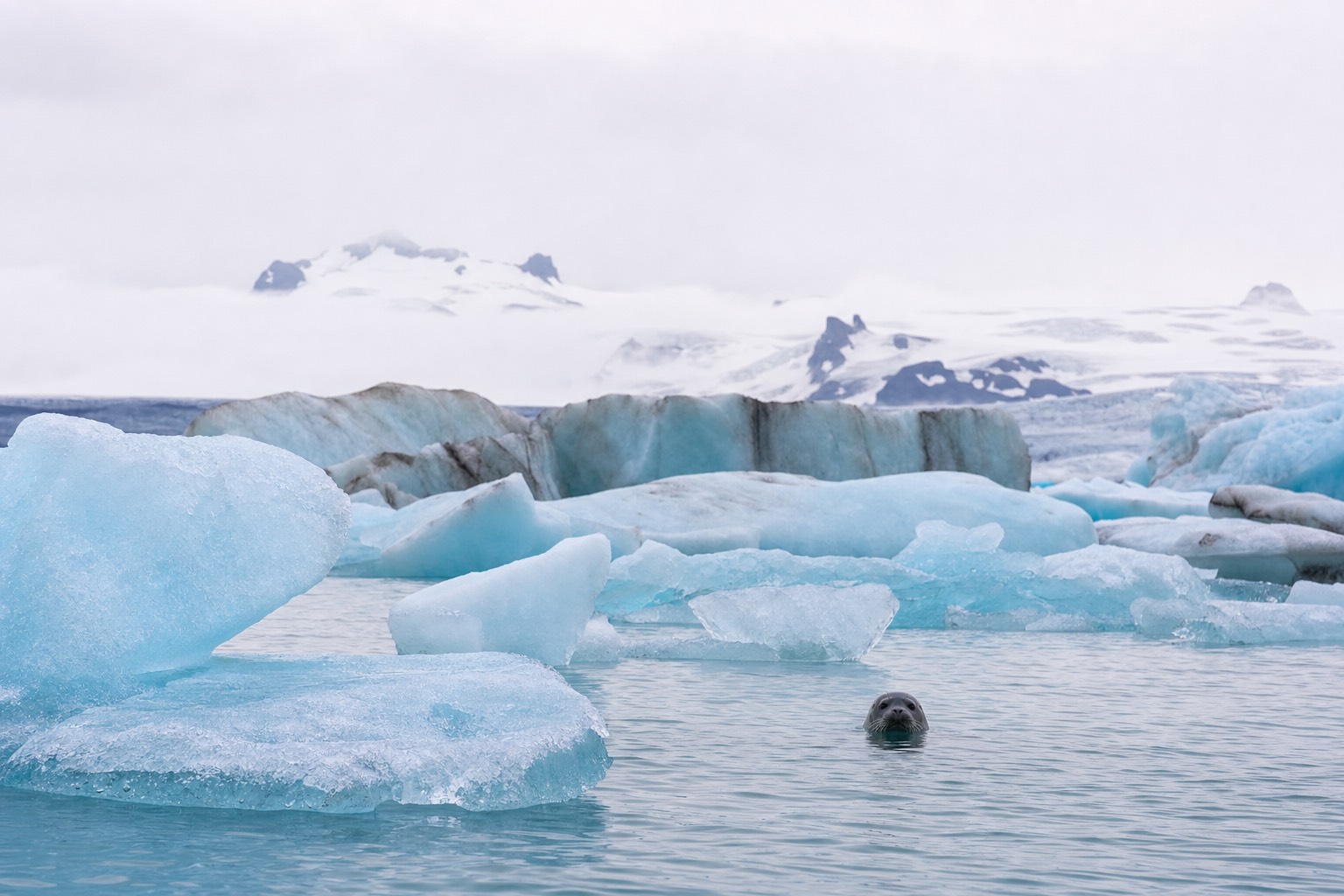
Stand at the lagoon on a still morning and the first thing you notice is the sound. Not silence, exactly, but a slow creak and knock as bergs the size of vans nudge each other and turn. Then a dark head breaks the surface, watches you for a breath, and slips under. I have guided this stretch of the south-east coast since 2020, and the lagoon still catches me the same way every time: it looks like scenery, but it is alive. Ice is calving off the glacier at the far end, seals are hunting the deep channel near the sea, terns are screaming overhead in summer. The postcard is only the surface of it.
Most people come to Jökulsárlón for the photograph and leave with the photograph. If you understand what you are actually looking at, though, the same hour and a half turns into something far stranger and better. So let me walk you through the ice, the animals, and the geology, the way I would if we were standing on the shore together.
Why is some of the ice electric blue and some milky white?
The colour is a record of how the ice was made. Dense, deep glacial ice has had the air squeezed out of it over centuries, so it absorbs every colour except blue and glows that vivid electric shade. Newer or churned ice is full of trapped air bubbles that scatter all light back, so it reads milky white.
It helps to think of the glacier as a slow printing press. Snow falls, more snow buries it, and the weight presses the lower layers into ice so compact that the trapped air is driven out almost entirely. Light hitting that airless ice travels deep before any of it bounces back, and the longer red wavelengths get soaked up along the way. What returns to your eye is blue. When a berg rolls and shows a face that has just cracked open, that fresh surface is often the bluest thing you will see all trip.
The stripes are my favourite part to explain. Those charcoal and black bands running through some icebergs are not dirt picked up on the beach. They are layers of volcanic ash, laid down on the glacier during eruptions decades or centuries ago, then buried and carried down inside the ice like pages in a book. Iceland is one of the few places on earth where you can read a glacier's eruption history in the side of a floating berg.
| Ice you will see | Why it looks that way | Roughly how old |
|---|---|---|
| Deep electric blue | Airless, highly compressed ice absorbs all light but blue | Centuries old, often the oldest ice showing |
| Milky white | Full of trapped air bubbles that scatter every colour | Younger or recently churned ice |
| Black or ash-striped | Layers of volcanic ash from past eruptions, compressed in | Records eruptions from decades to centuries back |
| Clear, glassy "diamonds" | Very dense ice, air-free, melts smooth and translucent | The oldest, densest fragments on the black sand |
That last row is the one that washes up across the road on the black sand, and it is a whole experience of its own. I get into it properly in what Diamond Beach is actually like.
How old is the ice floating in Jökulsárlón?
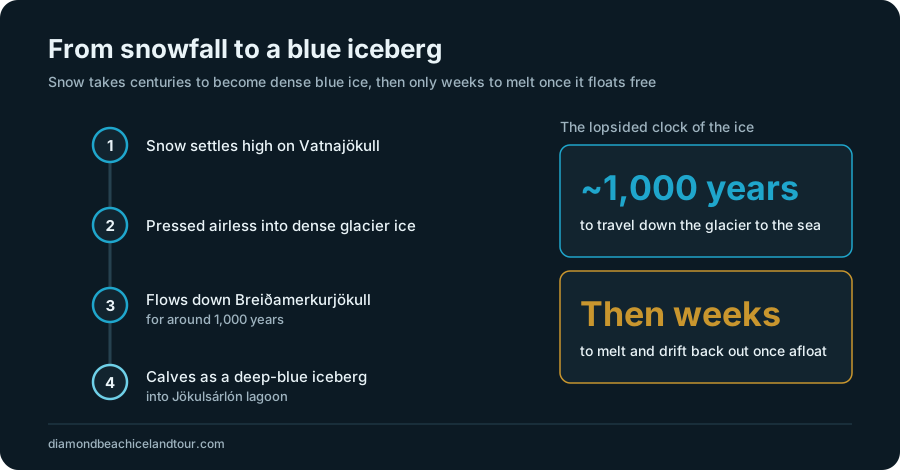
Older than almost anything else you will touch in Iceland. The ice calving into the lagoon fell as snow high on Vatnajökull and has been travelling down inside Breiðamerkurjökull for a very long time. Estimates commonly put the oldest bergs at hundreds of years old, with some ice reckoned to be around 1,000 years old or more by the time it reaches the water.
I never quite get used to saying that number out loud on the shore. Around a thousand years ago, the first settlers were still carving Iceland into farms and the island had barely been Christian a generation. The snow that fell then, on the high dome of the ice cap, is only now finishing its journey to the sea in front of you. That is not a marketing line. It is the plain physics of how slowly a glacier moves.
The ice does not survive long once it reaches the lagoon, which is part of what makes the visit feel urgent in a good way. Bergs drift, melt, roll and eventually ride the short river out to the Atlantic, sometimes washing back onto Diamond Beach on the tide. So the exact ice you photograph is genuinely a one-time thing. Nobody will ever see that particular berg in that particular shape again, and neither will you.
Are the seals at Jökulsárlón there all year?
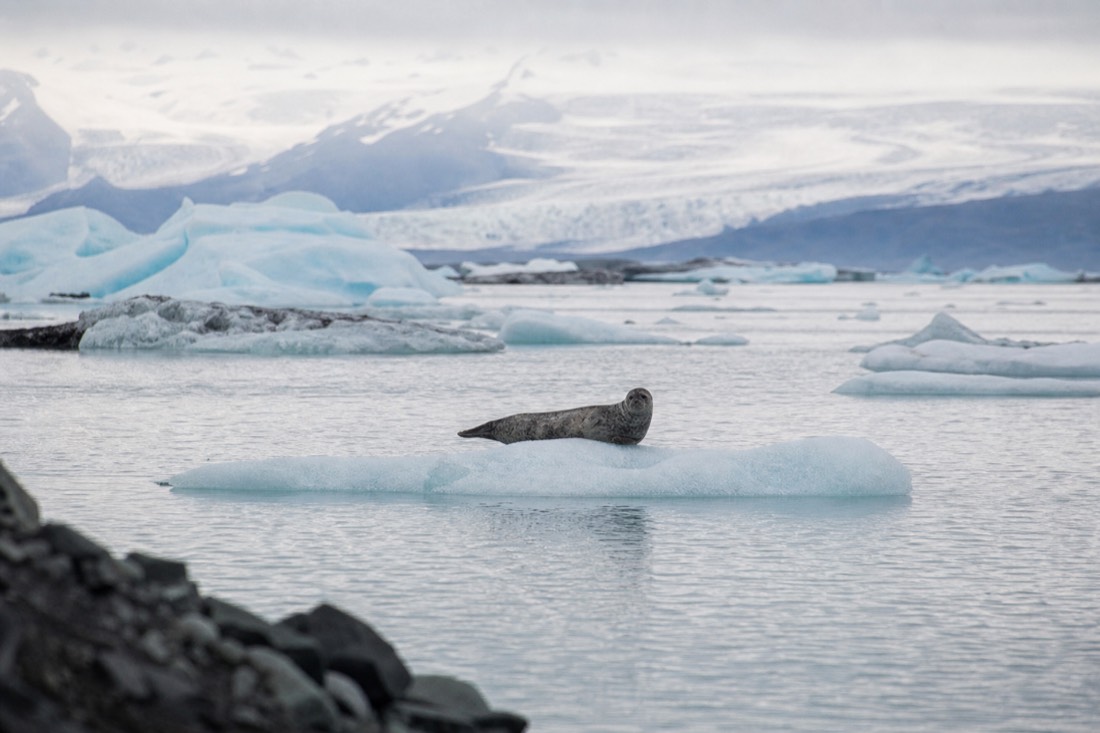
Yes. Harbour seals live at the lagoon year-round, drawn by the fish that run up the channel between the sea and the deep, cold water. You have a real chance of seeing them in any season, and locals will tell you the numbers often rise in winter, when seals move into the sheltered lagoon and haul out on the ice and low banks.
They are easy to miss if you are only scanning the big bergs. Look instead at the water near the river mouth, the narrow neck where the lagoon drains to the ocean, because that is where the fish concentrate and the seals follow. On a good day I have counted a dozen heads bobbing in that channel, popping up to watch the people watching them. In winter, with fewer boats and more ice to rest on, that channel can be busier still.
Here is the honest, unglamorous part, and it matters. These are wild animals in cold, fast-moving water, and the official guidance from Iceland's travel-safety service, safetravel.is, is to observe and never approach or feed them. Do not clamber toward a hauled-out seal for a closer shot, and never step onto floating or beached ice to reach one, because bergs roll without warning. Watch from the shore with a long lens or patient eyes, and you will see far more than the person scrambling around the rocks.
What birds nest around the lagoon and Breiðamerkursandur?
In summer the flats around the lagoon turn into one of the coast's busiest bird colonies. Arctic terns nest here in numbers, and great skuas, the big brown pirates locals call bonxies, breed on the black sands of Breiðamerkursandur nearby. Add eider ducks, fulmars and the odd gyrfalcon passing through, and the lagoon is a genuine wildlife stop, not just a scenic one.
The Arctic tern is the one you will remember, and possibly the one that draws blood. These are the world's champion migrants, flying from Iceland to Antarctica and back each year, and they defend their nests with a fearlessness that has to be seen. Walk too near a colony in June or July and they will dive at your head. Wave a hand above you and keep moving; it is their coast for those few weeks, and they are only doing their job. The Perlan museum's write-up on the Arctic tern is a good primer if you want to understand the bird before you meet it.
The great skuas are the heavies of the plain. They harry the terns, steal fish mid-air, and nest right out on the open sand where few other birds bother. Watching a skua chase a tern across the lagoon is a small aerial drama that most day-trippers walk straight past. The mix shifts hard by season, though, so set your expectations before you go.
| Wildlife | Best season | Where to look |
|---|---|---|
| Harbour seals | Year-round, often more in winter | River mouth and channel to the sea |
| Arctic terns | Late May to August (breeding) | Grass and gravel flats around the lagoon |
| Great skuas (bonxies) | Summer breeding season | Open black sands of Breiðamerkursandur |
| Eider ducks and fulmars | Spring through autumn | Sheltered water and low shoreline |
| Northern lights (not wildlife, but why) | Late autumn to early spring, after dark | Overhead on clear, dark nights |
If you want to know how the whole place shifts across the calendar, from summer bird noise to silent winter ice, I lay it out month by month in Jökulsárlón in every season.
How did Jökulsárlón form, and why does it keep growing?
The lagoon is young and getting bigger. It only began forming in the 1930s as Breiðamerkurjökull, an outlet glacier of Vatnajökull, retreated and left a basin that filled with meltwater. Since the 1970s it has roughly quadrupled in size, and it is now Iceland's deepest lake. Warmer water and a retreating glacier keep enlarging it every year.
That timeline still surprises people who assume the lagoon is ancient. Your grandparents' grandparents could not have visited Jökulsárlón, because it simply was not there. As the glacier pulled back from its historic maximum, the ground it had gouged out sat below sea level, and seawater plus glacial melt flooded in to make the lagoon we see now. The NASA Earth Observatory has tracked exactly this, documenting how the lagoon quadrupled in size since the 1970s as the ice withdrew.
The depth is the other headline. Because the glacier carved so deep, the lagoon now ranks as the deepest lake in Iceland, reaching well over 200 metres in places. That deep, cold, partly salty water is exactly why the seals and fish thrive here, and why the bergs can float so far before they ground. Every element of the place, the ice, the animals, the strange colour of the water, traces back to one fact: a great glacier is melting, and this basin is where it drains.
| Timeline | What happened |
|---|---|
| Before the 1930s | No lagoon; Breiðamerkurjökull sat near the coast |
| 1930s | Glacier retreat opens a basin that fills with meltwater |
| 1970s onward | Lagoon expands rapidly, roughly quadrupling in area |
| Today | Iceland's deepest lake, still growing as the glacier retreats |
| The ice itself | Snow that fell centuries ago, now calving and drifting out |
How do you take it all in without harming it, or yourself?
Give yourself the full stop, not a rushed one. Walk the shoreline slowly, scan the channel for seals before you chase the big bergs, and keep well back from the water and any floating ice. The lagoon rewards patience: the more still you are, the more moves around you. And let someone else handle the long drive so you arrive with energy to actually look.
This is where guided transport can earn its place for a lot of visitors. The lagoon sits about 380 kilometres from Reykjavík, a very long haul each way, and the driving is relentless. A Reykjavík coach lets someone else handle Route 1 while you save your attention for the shore. The optional lagoon boat belongs only to the relevant booked option, generally April to October when conditions allow, and wildlife sightings are never guaranteed.
A word on the boat, since people ask. The lagoon cruise is seasonal, roughly April to October and weather-dependent, not a year-round guarantee, so treat it as a bonus rather than the reason you came. From the water you get closer to the calving face and, on a lucky day, closer to the seals, though nothing about wildlife is ever promised. Whether the lagoon as a whole justifies the effort is a fair question, and I answer it honestly in is the glacier lagoon worth it.
Come for the ice, and you will. But stand still long enough and the place gives you more: a seal's dark eyes reading you from the channel, a tern screaming past your ear, a black-striped berg turning slowly to show you an eruption from a thousand years back. The lagoon is not a backdrop. It is a working piece of a melting glacier, full of animals that made a home in the meltwater, and it is changing faster than almost anywhere else you will stand in Iceland. See it while the ice is still this old.
Your Next Step
Match by starting point, travel month, age and water comfort
Initial editorial suggestion. Confirm your date and party requirements with the operator.
Have a travel date in mind? Check the Reykjavík departure and pickup option before arranging the rest of your South Coast day.
Ages 6+. Allow for delays. Meals are extra; glacier hiking and ice-cave visits are separate experiences.
Refine Your Choice And View Alternatives
Reykjavik: Jokulsarlon Glacier Lagoon & Diamond Beach Tour
14-hour coach trip from Reykjavík with an English-speaking guide, Jökulsárlón and Diamond Beach stops. Pickup and the seasonal boat ride depend on the booked option.
This tool compares tour formats, meeting points, listed ages, seasonal windows and duration. Seasonal guidance is not live availability. It does not confirm availability or personal suitability. Local activities do not include the drive from Reykjavík; leave extra time for travel and check-in.
Jökulsárlón Glacier Lagoon Kayaking Tour: A 1.5-hour guided paddle from the Jökulsárlón parking area, with a two-piece suit, sit-on-top kayak and equipment. English-speaking guide. Ages 14+, able to swim and comfortable in water. Not suitable for back or heart problems or those prone to seasickness. Arrive 20 minutes early; no Reykjavík transfer.
Jökulsárlón: Vatnajökull Glacier Guided Hiking Tour: A 4.5-hour outing from Jökulsárlón onto Breiðamerkurjökull, with an English-speaking glacier guide, Super Jeep transfer and glacier equipment. Ages 10+. A 4–6 km walk, medium difficulty; crampons fit EU 35–48. Pregnancy, heart conditions, recent surgery, low fitness or access needs require a different plan.